
TL;DR: This guide breaks down Google AI Overviews and Generative Engine Optimisation (GEO) for South African businesses, explaining how AI search retrieves sources, cites brands, and reshapes click behaviour. It gives a practical GEO and SEO framework you can apply, including schema markup, entity signals, author credibility, first-party evidence, and reporting metrics, then points you to next steps via an AI Visibility Audit and a GEO Quick Start Checklist.
Why Search Performance Feels Different
Imagine spending R50,000 a month on SEO. Rankings hold steady. Your pages still show on page one. Then click-through rate softens, and leads become harder to predict.
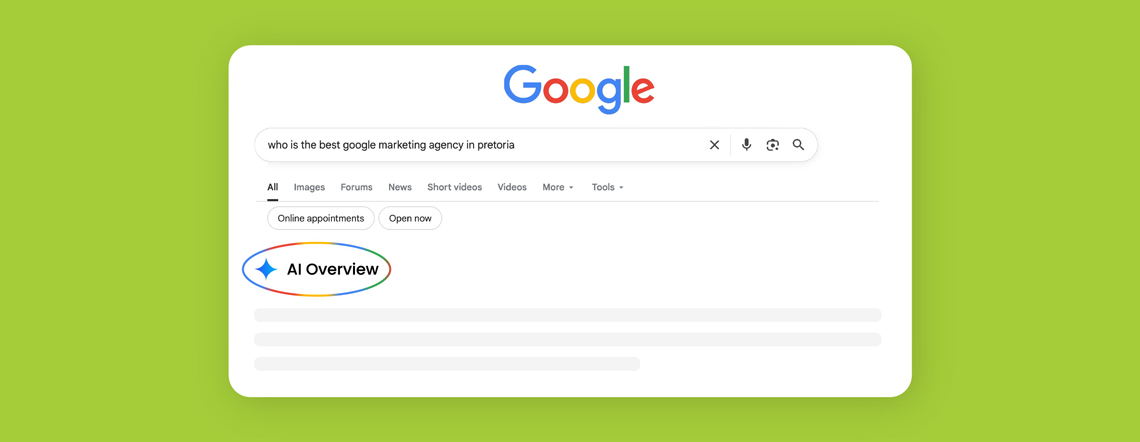
AI Overviews are a key driver of that shift. Google can now show an AI-generated summary above the traditional results for certain queries, with citations and links to supporting pages. Google explains these experiences in its guidance for site owners in AI features and your website.
The important change is measurement. Visibility and traffic can move in different directions. In BrightEdge reporting, Google search impressions rose, while click-through rates declined, with AI Overviews strongly linked to that change.
Here follows a practical framework that connects Search Engine Optimisation (SEO) and Generative Engine Optimisation (GEO), with steps South African teams can implement, track, and report.
Understanding AI Overviews and GEO
What are AI Overviews?
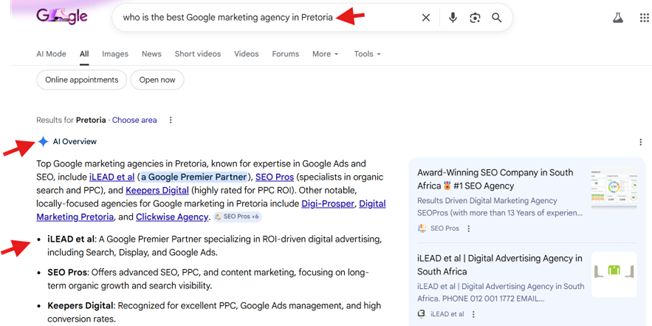
AI Overviews are AI-generated summaries that appear above the traditional results on some Google searches. Google describes them as a “snapshot” of key information with links to explore the web.
They tend to appear on:
- Definitions and explanations
- Comparisons and “best option” research
- Multi-step questions, planning, and cost breakdowns
- Complex topics that benefit from a synthesis
Adoption and exposure
Different datasets show different prevalence rates because query sets vary. McKinsey trend analysis estimates around half of Google searches include AI summaries, with projections rising beyond 75% by 2028.
Pew’s March 2025 analysis found AI summaries appeared on a smaller share of searches in its dataset, and it also measured a clear drop in clicking behaviour when an AI summary appeared.
The decoupling of visibility and traffic
AI Overviews can increase impressions while reducing clicks on many informational queries. BrightEdge reported impressions up and click-through rates down, with an estimate of a near 30% reduction in CTR since May 2024 in its reporting.
What is Generative Engine Optimisation
Generative Engine Optimisation (GEO) is the practice of shaping your content, entity signals, and site structure so AI-powered search engines can retrieve your information and cite your brand in AI-generated answers.
Traditional SEO focuses on ranking well in the SERPs and earning qualified traffic. GEO expands the visibility layer to include:
- Citations inside AI Overviews
- Brand mentions in AI-generated answers
- Inclusion across multiple AI search experiences
What is SEO in digital marketing
If someone searches “what is SEO in digital marketing”, a clean answer is: SEO is the work that improves your organic search visibility so your business appears for relevant queries, earns qualified visits, and drives measurable outcomes.
For South African businesses, SEO remains a core part of digital marketing strategy because it supports long-term lead generation, trust, and brand visibility. For a view of iLEAD et al’s SEO offering, see our Search Engine Optimisation services.
How does SEO work alongside AI Overviews
If the question is “how does SEO work” in 2026, the answer includes classic fundamentals plus GEO execution.
SEO fundamentals support AI visibility because AI systems still rely on strong sources. Google’s site-owner guidance for AI features reinforces the focus on quality, structure, and accessibility.
GEO adds emphasis on:
- Entity clarity
- Structured data
- Citation-ready answers
- Evidence, authorship, and trust signals
How AI Search Selects Sources
Traditional SEO vs GEO
Area | Traditional SEO | GEO in AI search |
Primary output | Ranked links in SERPs | AI-generated answer plus citations |
Selection focus | Relevance, authority signals, page quality | Retrieval quality, entity signals, trust, structure |
User behaviour | Click to learn | Skim answer, click selectively |
Content that performs | Strong pages aligned to intent | Clear passages that define, explain, compare, and cite sources |
Retrieval before generation
Many AI search experiences retrieve sources first, then generate an answer grounded in those sources. This is often described as retrieval-augmented generation (RAG). The optimisation implication is practical: the system needs content it can find, interpret, and cite confidently.
Authority signals and domain age
SE Ranking analysed 2,000 queries across AI search engines and reported that the average age of domains cited in responses sat around 17 years for ChatGPT and Google AI Overviews in its dataset.
That does not create a barrier for newer businesses. It highlights the value of consistent authority-building and clean entity signals.
What AI engines look for:
- Structured data and schema markup that matches on-page content
- Entity relationships across organisation, services, people, and locations
- E-E-A-T signals, especially on high-stakes topics
- First-party evidence such as original data, research, and case studies
- Clear definitions and step-by-step guidance
- Content freshness in categories that change frequently
AI Search in South Africa
AI search behaviour is already visible in South African internet usage patterns. Similarweb’s January 2026 rankings place chatgpt.com as the fourth most visited website in South Africa.
This matters even when Google remains the primary channel. AI tools influence research behaviour, shortlisting, and the language users adopt when they search.
McKinsey also reports that half of consumers polled intentionally seek out AI-powered search engines, based on its AI Discovery Survey.
Industry Impact and Practical Implications
- Healthcare and medical services
Health queries are high stakes. E-E-A-T needs to be prominent, with author credentials, review notes, and references to primary sources where appropriate. Reporting has raised concerns around disclaimer visibility in AI Overviews in medical contexts, which adds pressure for accuracy and sourcing discipline.
- Financial services
Finance content requires precision and compliance-friendly phrasing. GEO work here benefits from clean definitions, structured data, and clear boundaries between education and advice.
- E-commerce and retail
AI Overviews can summarise comparisons, buying guides, and product differences. Category pages, product FAQs, and structured product information help visibility for research queries.
- Professional services
For legal, engineering, consulting, and similar services, AI Overviews become an early filtering layer. Strong thought leadership, author pages, and case studies support both citations and conversion trust.
- B2B and technology
Technical buyers use AI to understand concepts quickly. Clear documentation, definitions, and implementation guides often perform well in retrieval-driven selection.
Stats callout: Semrush reported that the average AI search visitor it tracked converted at a higher rate, and it quantified AI visitors as 4.4 times as valuable by conversion rate in its dataset.
GEO Strategy Framework for South African Businesses
Step 1: Audit your current AI visibility
Build a baseline you can track monthly.
- Search your priority queries and record AI Overview presence
- Record which pages and competitors are cited
- Track branded and non-branded mentions across your key topics
- Note which of your pages already contain clear, quote-ready answers
For a structured auditing approach, see iLEAD et al’s Digital audits services.
Step: 2 Create citation-ready content
GEO-friendly content remains human-friendly content. The difference is structure and evidence.
- Add short definitions near the top of key sections
- Use descriptive subheadings that match real intent
- Include comparison tables where decisions involve trade-offs
- Add step-based guidance for processes and planning queries
- Support claims with first-party data or credible external research
Step 3: Strengthen E-E-A-T signals
- Add author bios with real experience and credentials
- Include editorial notes on sensitive topics
- Publish first-party research, even small datasets
- Add case studies with context, timelines, and outcomes
Step 4: Implement structured data that matches content
Structured data helps machines interpret meaning reliably, as long as it reflects real on-page content.
- Organisation schema
- Article schema with author and dates
- FAQ schema for genuine FAQs
- HowTo schema for implementation guidance
- Breadcrumb schema for structure
Step 5: Build citation-worthy authority off-site
- Digital PR and credible media mentions
- Partner pages and reputable directories
- Industry contributions and webinars with recap pages
- Consistent brand entity signals across major platforms
Implementation Steps
Weeks 1 & 2:
- Add or improve FAQs on your highest-value pages and apply FAQ schema
- Add author bios and credentials to cornerstone content
- Rewrite key sections to include clear definitions and scannable steps
- Improve internal linking to reinforce topical clusters
First quarter
- Run a content audit focused on AI Overview opportunities and entity clarity
- Create structured data templates for consistent implementation
- Refresh high-performing pages with stronger evidence and clearer answers
- Set up reporting that includes AI feature visibility and CTR shifts
Next two quarters
- Publish first-party research on a consistent cadence
- Build case study assets that support credibility and conversion
- Run authority campaigns tied to priority services and sectors
- Maintain testing and refinement as AI features change
Measuring GEO Success
Track performance with a blended view of SEO and GEO.
GEO metrics to track:
- AI Overview appearances on priority queries
- Citation frequency and which URLs are cited
- Branded mentions versus non-branded mentions
- CTR movement on queries where AI Overviews appear
- Conversions and assisted conversions tied to organic visibility
Pew’s click behaviour research provides a useful reference point for measuring changes in click-through patterns.
Tools and reporting
- Google Search Console for traditional SEO signals
- An AI feature tracker for AI Overview monitoring
- A monthly dashboard that merges SEO traffic, AI visibility, and conversions
Common Mistakes to Avoid
Dropping SEO fundamentals
Technical SEO, clean structure, and content quality remain foundational, and Google’s AI features guidance supports that emphasis.
Over-tuning for machines
Clarity wins. Evidence wins. Structure supports both humans and retrieval systems.
Focusing on one platform
South African usage patterns show strong AI tool adoption alongside Google. Similarweb’s rankings make that clear.
Treating AI Overviews as purely informational
AI touchpoints influence purchase decisions and shortlisting. McKinsey’s survey findings speak to that.
Ignoring safety and verification
AI Overviews have been shown to surface incorrect contact details in scam contexts. Build safeguards into your processes for phone numbers, addresses, and medical guidance.
What the next phase of search looks like
Google continues to adjust how AI Overviews show sources and links. Recent reporting covers updates that make links more visible in AI Overviews and AI Mode.
The practical implication for SA businesses stays consistent:
- Invest in content that can be cited cleanly
- Strengthen entity signals and structured data
- Report beyond rankings, including AI visibility and conversion quality
Frequently Asked Questions bout GEO
Q: What are AI Overviews in Google Search?
A: AI Overviews are AI-generated summaries that appear above traditional search results for some queries. They aim to provide a snapshot answer with citations and links to supporting sources.
Q: What is GEO and why does it matter for South African businesses?
A: GEO is Generative Engine Optimisation, the work that improves your chances of being cited or mentioned in AI-generated answers. It matters in South Africa because AI tools are already heavily used, and they influence research and purchase decisions.
Q: What is SEO in digital marketing in 2026?
A: SEO is the process of improving organic search visibility so your business appears for relevant queries and earns qualified traffic and outcomes. It includes technical SEO, on-page SEO, content optimisation, and authority-building work.
Q: How does SEO work when AI Overviews appear on my target queries?
A: SEO still supports visibility, and it increases the likelihood of your pages being retrieved as sources. AI Overviews can reduce clicking behaviour on some queries, so measurement should include impressions, CTR shifts, citations, and conversions.
Q: What is an SEO strategy that supports GEO outcomes?
A: A strong “what is an SEO strategy” answer in 2026 includes: technical hygiene, topic clusters, entity clarity, structured data, and authority assets such as case studies and first-party research. It also includes measurement that tracks AI feature visibility and citations.
Q: How to improve SEO when CTR drops on informational queries?
A: “How to improve SEO” in this context means shifting focus to citation-ready content, higher-intent pages, and conversion pathways. Improve definitions, add structured FAQs, strengthen internal linking, and tighten page experience. Track assisted conversions, not only last-click conversions.
Q: How can I check if my business appears in AI Overviews?
A: Search your priority queries, record AI Overview presence, and note which sources are cited. Repeat monthly and track your brand mentions on both branded and non-branded queries. An audit service can formalise that baseline and reporting.
Q: Do SEO agencies South Africa offer GEO tracking and implementation?
A: Some do; many are still building capability. A practical way to evaluate “SEO agencies south africa” is to ask for examples of AI Overview tracking, schema implementation standards, and reporting that includes citations and AI feature visibility.
Q: What structured data has the biggest impact on AI visibility?
A: Organisation schema, Article schema with authorship and dates, FAQ schema, HowTo schema, and Breadcrumb schema tend to support interpretation and retrieval when implemented correctly and aligned with on-page content.
Q: Which industries see AI Overviews most often?
A: Industry exposure depends on query type, intent, and the way Google triggers AI summaries. BrightEdge reported strong AI Overview presence in sectors such as healthcare, education, B2B technology, and insurance in its reporting period.
Check Your AI visibility, Then Act On It
AI Overviews and AI-powered search are reshaping discovery and decision-making. A modern approach pairs SEO and GEO:
- SEO builds foundational visibility in the SERPs
- GEO increases the likelihood of citations and mentions in AI-generated answers
- Structured data and entity optimisation improve interpretation and retrieval
- Authority building supports trust and selection
iLEAD et al’s advantage is an integrated approach across search and content, backed by Google Premier Partner status and measurable implementation. When acronyms and technical terms get too overwhelming, consult our SEO experts for a sound strategy aligned to an AI-visible future.