
Since its widespread adoption, AI has been touted as many things. In marketing specifically, it has become the default tool in the pursuit of efficiency. However, when everyone utilises the same tools to reach the same objectives, we face a rising tide of “AI slop” and a “sea of sameness“. So, we need to ask: Do these tactics lose their advantage? Wouldn’t striving for marketing effectiveness be a better starting point for your brand in the age of AI?
In this article, we explore how focusing on brand strategy can ultimately improve the effectiveness of your growth efforts.
Your Brand in the Age of AI: Efficiency vs. Effectiveness
Let’s distinguish the two. Based on Peter Drucker’s renowned definition, “efficiency is doing things right; effectiveness is doing the right things,” we should start by defining parameters for effectiveness.
Applying this rule to digital marketing means that sound strategy starts with establishing strong foundations for your brand in the age of AI. Brands with distinctive and meaningful values and expressions will have a stronger appeal to customers who share those values. Next, we continually need to culture-stress test our approach to ensure that we can grow this segment into the future. Thus, with brand foundations in place, the efficiency drive will multiply, resulting in maximised commercial outcomes.
Does AI mean the Brand’s Extinction or Evolution?
With the onset of any new technology or channel, many argue that previous disciplines are rendered obsolete. We see this clearly in the case of SEO. With the rise of zero-click searches, many have touted the medium dead, while the opposite is proving to be true. SEO remains an important foundation; however, to stay relevant and competitive within the new AI-led landscape, it must expand to include:
- AEO – Answer Engine Optimisation: The process of optimising content to appear in direct answers provided by AI assistants and voice search (e.g., ChatGPT, Claude, Perplexity).
- GEO – Generative Engine Optimisation: Optimising content to increase visibility within AI-generated responses by focusing on brand citations, authoritative references, and sentiment.
- AIO – AI Overviews: Google’s specific feature (formerly SGE) that provides generative AI summaries at the top of search results, citing multiple web sources.
- SXO – Search Experience Optimisation: A methodology that combines SEO and User Experience (UX) to ensure that once a user finds a site via search, the journey is seamless and leads to a conversion.
As AI’s share of search grows, so does the need to equip machines with the structured data they need to synthesise meaningful answers. AI engines’ searches are deeper and more comprehensive than previous algorithms. As we transition from providing relevant links to providing relevant answers, it is important to remember that every AI chatbot is tasked with finding the best solution to a user’s query. Because these results are more involved, AI requires more data and higher-quality signals.
In addition to traditional technical signals, today’s results rely more than ever on the strength of your brand. In the AI world, this is a measurement nomenclature provided by Ahrefs:
- Branded Mentions: The strongest predictor of AI visibility is how often your name appears on authoritative third-party sources.
- Branded Anchors: A measure of your brand as a link reference, which signals authority and a consistent digital identity.
- Branded Search Volume: A long-standing measure of how many people actively search for your brand, serving as a proxy for awareness that AI can quantify.
- Domain Rating: Your overall digital authority. While newer brand signals are gaining prominence, this remains a relevant foundation.
Only a strong brand can tip the balance in your favour.
How to Build and Strengthen Your Brand in an AI-Algorithmic World
A good place to start is by building a strong foundation. The simplest model juxtaposes your brand’s values (what you stand for) with those of your customers (what they care about). The middle ground where these two meet is where you truly appeal to your target audience.
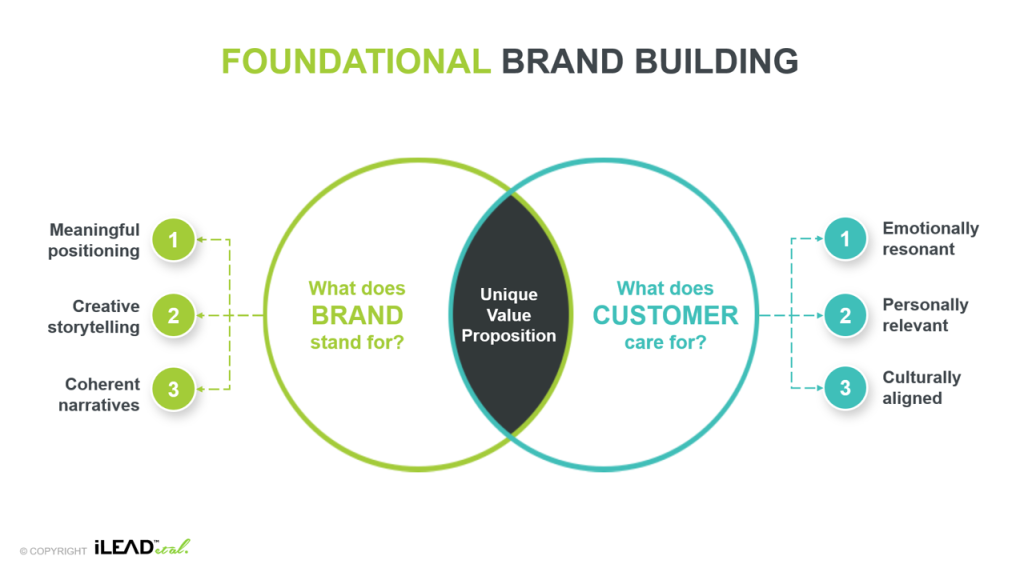
The larger this overlap, the larger your potential market share. To grow this space, you must continually test and refine your positioning and how you relate to your customers. To ensure your audience wants to engage with you, evaluate your brand against three key pillars:
- Emotional Resonance: Does your brand spark a genuine feeling?
- Personal Relevance: Does it solve a specific problem or fulfil a need?
- Cultural Alignment: Does it fit within the current values and conversations of the day?
This scale helps you diagnose the specific areas of your positioning that require fine-tuning. However, remaining competitive in an AI-mediated world requires a second step: once your brand is calibrated for human memory, you must progress to make it machine-readable.
Human Memory vs. Machine Readability: A Dual Approach
Brand marketing has been built over centuries through emotional storytelling and personal experiences. For a brand to be chosen, it relies on the emotional connections people feel. These are the connections that drive a willingness to pay a premium. It is worth noting that price elasticity remains one of the ultimate measures of a brand’s strength.
In addition to this human connection, we must now create a layer of information delivered in a format that machines can read and synthesise into answers. To reach the top of AI citations and recommendations, we must understand the “machine brain,” which is geared toward providing the most accurate answer to the user. These engines’ primary motive is to keep users engaged by delivering results that are relevant, clear, and unambiguous.
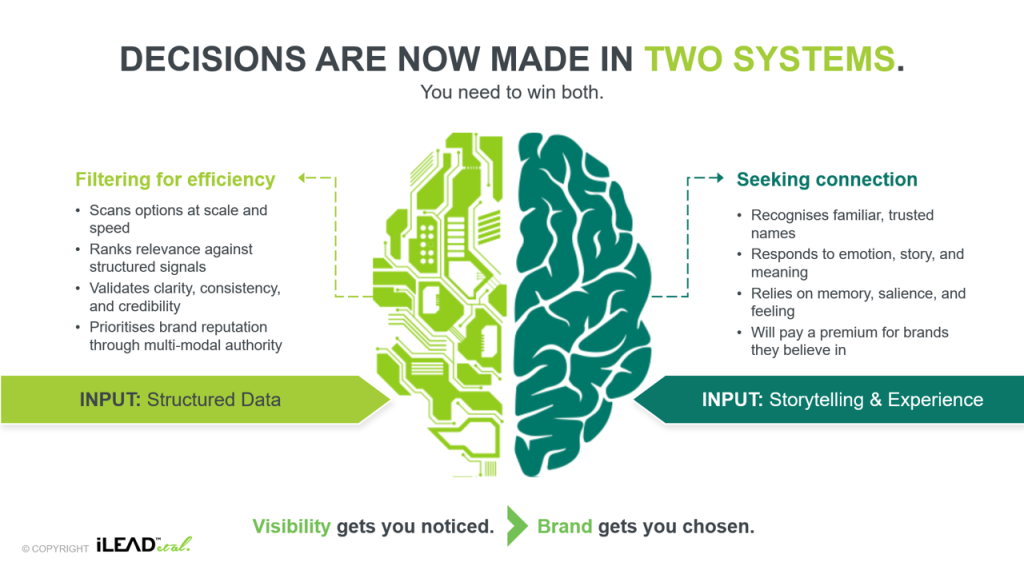
To appear in these results, you must ensure, firstly, that you have a clearly defined brand proposition; and, secondly, that you have provided it in a structured format machines can parse. Beyond your own website, AI evaluates your credibility by assessing brand mentions across third-party publishers and conversational media. It seeks to ensure your brand statements are validated by the real-world experiences of actual people.
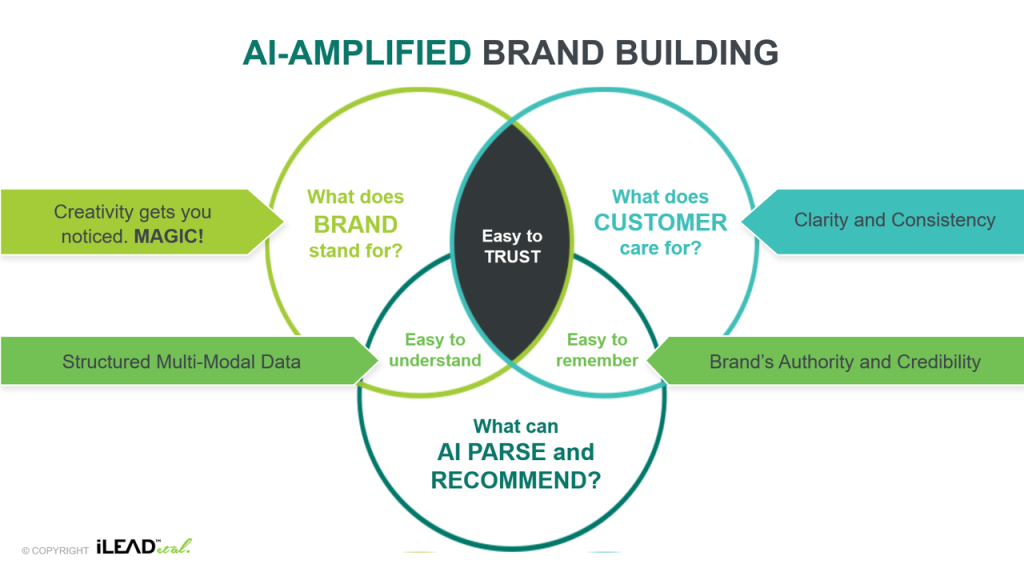
As we evolve alongside AI systems, we have a simultaneous obligation to keep investing in the human portion of the ecosystem. Ultimately, brand marketing is not aimed at algorithms, but at the humans who use them.
New Audience Profiles: Addressing the Multi-Level Journey
As AI technologies advance, they are becoming deeply integrated into our daily lives and shopping journeys. Recent research from Kantar identifies four levels of AI integration:
- Human-Driven: The majority of today’s users who utilise AI primarily as a sophisticated tool to stay informed, while keeping the decision-making process firmly under human control.
- Curated: Deeply engaged users who treat AI as a research partner, “curating” and training chatbots to provide personalised, highly researched recommendations and insights.
- Researcher: A segment particularly prevalent in the B2B sector, where 89% of professionals now cite AI as a primary source of information, relying on AI to synthesise complex data to guide professional outcomes and strategic decisions.
- AI-Driven: The fastest-growing cohort, consisting of users who deploy autonomous “agents” to perform tasks and act on their behalf within the digital ecosystem.
The numbers are conclusive: for your strategy to be resilient, your brand must become machine-readable.
The Evolved User Journey
While the ecosystem has been expanding, the way decisions are made has started to simplify, with AI taking on the role of a personal shopping assistant. To help our clients navigate this complexity, we have evolved our user journey model, which now comprises two foundational blocks: Discovery and Decision-Making.
Think of Discovery as the new “awareness” phase. It encompasses the entire omnichannel journey, including AI-driven channels. To ensure their answers are authoritative, AI engines fetch data from sites they deem credible, ranging from your owned website to third-party media and forums, like Reddit, where real humans provide authentic recommendations. This means your media strategy must now cater to these human opinion-shapers as much as the end-consumer. This is a fundamental shift in how media is deployed and measured.
The crucial element connecting Discovery and Decision-Making is a new conversational segment: the Dialogue. This is the real-time interaction users have with their AI assistants. When creating content for this phase, think “answers-first.” Put on the customer’s hat and provide the specific information they seek to find the best solution.
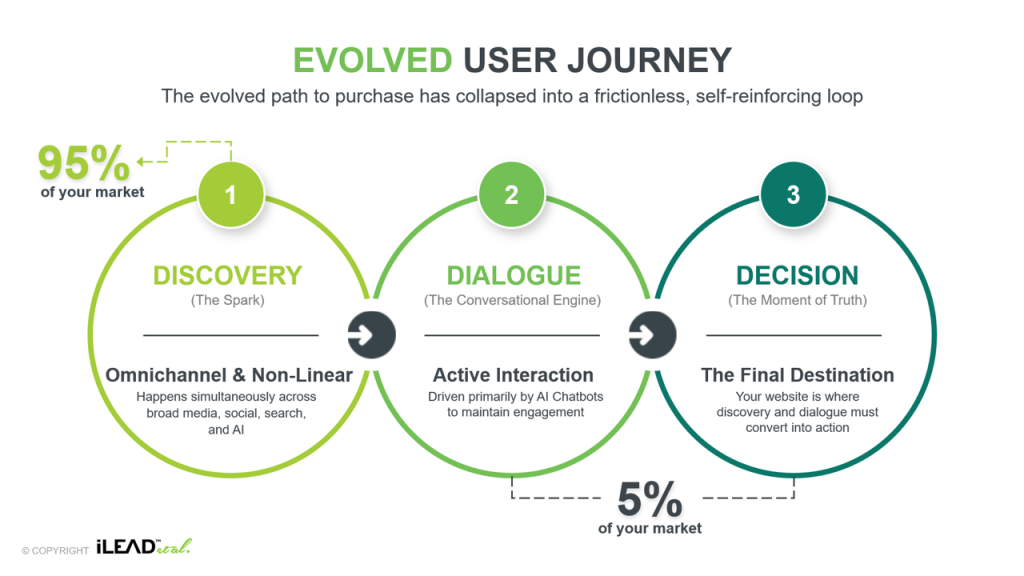
Finally, ensure your owned channels – your website and app – are both frictionless and interactive for humans, but also structured and machine-readable for AI. This is where the actual purchase happens, and where your brand must ultimately “win.”
An AI-Ready, Full-Funnel Media Strategy to Boost Your Brand in the Age of AI
A multi-channel media strategy is essential for connecting the dots in the modern journey. Because decision-making is now shaped by both human memory and AI output, these two systems must work in unison. Similar to brand building, your media must ensure your brand is top-of-mind for the person and top-of-results for the machine.
A robust media strategy begins with broad reach and high-impact formats that drive recognition and familiarity. When boosted by digital capabilities, these formats provide a sophisticated layer of trackability and measurement. To win across the full funnel in an AI-mediated world, your media must:
- Prioritise attention: Place your brand in premium, high-attention, and brand-safe environments using advanced native targeting.
- Humanise the brand: Leverage social platforms and creator content to provide the personal perspectives, authenticity, and earned credibility that humans (and AI) value.
- Connect on the move: Utilise high-impact outdoor and Uber media to reach commuters, backed by advanced tracking and measurable results.
- Master the AI ecosystem: Use Google’s AI tools to capture today’s demand by synthesising Search and SEO into AI-powered answers, while fuelling future demand through Demand Gen.
- Treat AI as a distinct channel: Build visibility through structured content and authority, utilising dedicated GEO, AEO, and AIO strategies.
In the next article, we unpack how this full-funnel media strategy serves as the engine for brand growth in the age of generative search.
As Head of Strategy and Innovation at iLEAD et al, Kristina focuses on the intersection of brand building and technological evolution. She is passionate about creating future-fit marketing strategies that turn audience insights into measurable business results.