
- It’s finally here: ChatGPT Ads is now live in South Africa, following OpenAI’s announcement on 21 October 2026.
- ChatGPT leads AI referrals locally. It accounts for 80.30% of measured chatbot referral traffic in South Africa, according to Statcounter’s September 2026 data.
- Ads can appear on eligible Free and Go accounts. Plus, Pro, Business, Enterprise, and Edu remain ad-free. Go is a paid plan.
- B2B reach has limits. Decision-makers using Enterprise workspaces will not see adverts there, although they may encounter them through personal Free or Go accounts.
- Advertising does not influence ChatGPT’s answers. Buying a placement does not purchase an AI recommendation.
- The right media mix depends on the client. Google Ads, Meta, and TikTok offer other opportunities to reach prospective customers, including people whose ChatGPT accounts are ad-free.
Why the launch matters, who can see the ads, and how iLEAD et al clients can trial it.
It’s finally here. After launching in other markets first, ChatGPT Ads is now live in South Africa. For local advertisers, this is an exciting moment: brands can now appear in the conversations South Africans are already having with the country’s leading AI chatbot.
OpenAI announced the rollout of ChatGPT Ads to South Africa on 21 October 2026, opening a new way to reach potential customers during online research. Making the most of it starts with understanding how the platform works.
Who can actually see these adverts? Can they reach corporate decision-makers? How should businesses evaluate them alongside established advertising channels?
At iLEAD et al, we invite our clients to trial ChatGPT Ads with us. Our Google Premier Partner experience and paid social expertise provide the foundation for that work. We are examining the platform’s capabilities and limitations so that our advice reflects what businesses can realistically achieve.
This article explains the confirmed position at launch. We will share further guidance as OpenAI releases more detail.
Why does ChatGPT Ads matter in South Africa?
Statcounter’s September 2026 South African dataset reports the following:
AI platform | Share of measured chatbot referral traffic |
ChatGPT | 80.30% |
Google Gemini | 8.70% |
Microsoft Copilot | 6.15% |
Perplexity | 3.71% |
Claude | 1.14% |
ChatGPT leads this dataset by a wide margin, with more than nine times Google Gemini’s share.
However, Statcounter measures chatbot referrals to websites within its tracking network. These percentages describe referral traffic, rather than unique users or total conversations.
They cannot establish the size of South Africa’s eligible Free and Go advertising audience.
For advertisers, the opportunity is clear. ChatGPT already sends more referral traffic to websites than any other AI chatbot in South Africa. ChatGPT Ads now gives brands a way to appear in the conversations behind that traffic.
What has launched in South Africa?
OpenAI announced South Africa’s inclusion in its expansion to 26 additional advertising markets on 21 October 2026. The rollout allows advertisers to explore opportunities to reach eligible users within ChatGPT.
The opportunity will look different for every advertiser.
A business selling specialist corporate services faces a different audience challenge from an online retailer. Our assessment starts with those differences: who the client needs to reach and whether the available advertising environment provides credible access to them.
Who can see ChatGPT Ads?
OpenAI’s eligibility guidance makes an important distinction between subscription tiers:
ChatGPT subscription |
Can ads appear? |
Free | Yes, subject to eligibility |
Go | Yes, subject to eligibility |
Plus | No |
Pro | No |
Business | No |
Enterprise | No |
Edu | No |
Go is a paid subscription, so describing ChatGPT Ads as reaching only free users would be inaccurate.
OpenAI also excludes Temporary Chats and accounts identified as belonging to under-18s, and avoids showing ads alongside sensitive topics such as health, mental health and politics. Free users can also choose an ad-free experience with lower usage limits and fewer features.
Paid placements reach eligible users, rather than ChatGPT’s entire user base.
What should B2B advertisers plan for?
A business hoping to reach decision-makers at major corporations needs to understand where advertising can appear.
If a procurement manager researches suppliers through a ChatGPT Enterprise workspace, an advertiser cannot reach them with a ChatGPT advert inside that workspace.
The same individual might use a personal Free or Go account. That creates a possible opportunity, but provides no assurance that a campaign will reach them.
Subscription type also cannot establish purchasing authority. A business owner using Free may control a substantial budget. A Plus subscriber may have no involvement in corporate purchasing.
For iLEAD et al, the question is whether the available targeting provides sufficient access to relevant prospects. A trial helps answer that question with evidence.
How does ChatGPT advertising work?
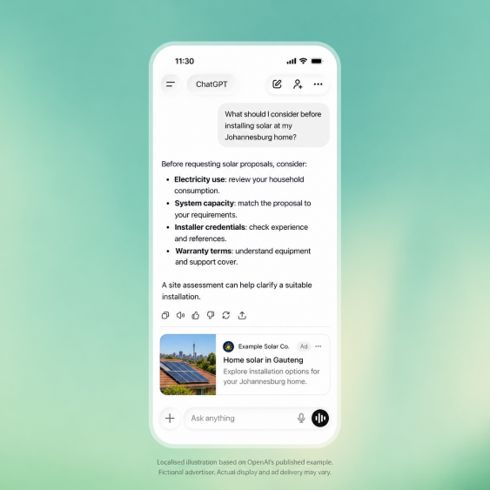
Figure 1: Illustrative solar advert for a Johannesburg homeowner, showing the sponsored placement and advertising disclosure. Adapted from OpenAI’s published example; the advertiser is fictional – https://ads.openai.com/
ChatGPT can give users space to explain their requirements in detail. A conversation may develop as someone compares options and asks follow-up questions. This creates a potential advertising opportunity around the problem being explored.
For example, a business owner researching accounting software might discuss integration requirements and reporting needs. An eligible placement could introduce a relevant supplier during that process.
OpenAI’s advertiser documentation describes ads below responses. Advertisers can supply “context hints” describing relevant situations or topics, but these do not function as exact-match keywords or guarantee placement against a particular question.
Familiarity with search advertising provides useful context, but ChatGPT’s own delivery rules require separate scrutiny.
Can advertisers pay to influence ChatGPT’s answers?
OpenAI states that advertising does not influence ChatGPT’s answers. Paid placements are separate and labelled. An advert is not an OpenAI endorsement.
Businesses should distinguish between paid placement and organic visibility in AI-generated answers.
An advertising campaign does not purchase a recommendation within an answer. Work on useful website content and credible business information remains a separate part of the wider marketing strategy.
How does Google Ads fit into the picture?
Google Search provides opportunities to reach people actively looking for relevant products or services. A search such as “industrial refrigeration supplier Johannesburg” can express a specific commercial requirement.
Google Search campaigns allow advertisers to compete for relevant searches, including searches made by people whose ChatGPT accounts are ad-free.
Our established Google Ads offering spans Search, Shopping, YouTube, and Display. Campaign selection and management are guided by the client’s objectives.
As a Google Premier Partner, iLEAD et al brings relevant platform experience to these decisions. Google describes its partner badges as recognising expert-level Google Ads knowledge, supported by training and product insights.
That experience gives us a basis for evaluating where an additional channel might contribute. Existing campaign results can inform the questions we ask of a new platform, particularly around audience quality and commercial outcomes.
Where do Meta and TikTok fit?
Customers may encounter a business before actively searching for its offering. Paid social can introduce an unfamiliar service and help prospective customers understand its relevance.
iLEAD et al’s paid social approach covers Meta’s Facebook and Instagram, alongside TikTok, within a broader digital strategy.
Facebook and Instagram
A proposed Meta campaign might explain a service through video and follow up with eligible audiences who engaged. The creative should address the information a prospective customer needs before taking action.
Where permitted, customer data and website engagement can support audience development. Platform rules and consent requirements still apply.
TikTok
TikTok requires creative suited to its viewing environment. A useful product demonstration may communicate more effectively than a conventional corporate advert adapted to vertical video.
The platform supports lead generation through instant forms or an advertiser’s website, subject to feature availability and eligibility.
ChatGPT Ads adds a new layer to these established options. The appropriate balance will depend on the client, rather than a predetermined allocation to every platform.
What could a coordinated strategy look like?
Consider an illustrative commercial solar campaign.
Meta could help explain the financial considerations of an installation. Google Search could capture enquiries from businesses actively seeking providers. ChatGPT Ads could potentially add exposure among eligible users exploring their requirements.
This is an illustrative application, not a fixed media plan.
A controlled test shows whether that layer earns its place in the budget. A coordinated strategy also needs realistic assumptions about tracking. Discussing a product in ChatGPT does not, by itself, create an audience an advertiser can retarget on Meta. Nor should a media plan assume that every prospect follows the same sequence of platforms.
What targeting and costs should advertisers expect?
OpenAI’s campaign guidance documents location targeting, with more detailed geographical options where supported. Advertisers need to verify the controls available to their accounts. Custom audiences are supported, but inclusion requires at least 25,000 matched users, which many niche B2B lists will not reach. Named-company or job-title targeting should never be assumed.
Its advertiser documentation describes impression-based and valid-click billing, alongside conversion optimisation for supported events. Conversion measurement requires setup. No universal South African cost per lead can responsibly be promised.
Each trial looks at what the platform can track and how those measurements connect to meaningful business outcomes. An inexpensive enquiry has limited value if it comes from someone the client cannot serve.
How does privacy work with ChatGPT Ads?
OpenAI says advertisers cannot access private chats or memories. Conversational context and, depending on settings, personalisation signals can still inform advertising relevance.
Advertisers must also assess their own tracking and lead-collection practices. A platform’s privacy commitments do not resolve every governance question for the business using it. We will address these considerations with any client before a campaign goes live.
What happens next for iLEAD et al clients?
We invite our clients to trial ChatGPT Ads with us, with full disclosure of the platform’s limitations from the start.
Each trial focuses on four questions:
- Audience suitability: Whether the available controls provide credible access to the client’s market.
- Commercial purpose: What additional contribution the channel could make.
- Measurement requirements: How worthwhile outcomes could be assessed.
- Budget implications: Where a controlled test could be justified alongside existing activity.
The results of each trial guide the next step for that client.
Where could your advertising work harder?
The arrival of ChatGPT Ads makes this a useful time to examine your media strategy. Which audiences are your campaigns reaching? Where are valuable prospects being missed? What evidence should guide your next investment?
Ask iLEAD et al to review your advertising strategy against your business goals. Our Google Premier Partner expertise and paid social experience can help identify gaps in audience coverage and opportunities to improve the allocation of your budget.
If you would like to trial ChatGPT Ads with us, let us know.
Talk to us about trialling ChatGPT Ads
Frequently asked questions about ChatGPT Ads in South Africa
Is ChatGPT Ads available in South Africa?
Yes. OpenAI announced South Africa’s inclusion in its advertising expansion on 21 October 2026. Advertisers should confirm their account’s access and available campaign options through Ads Manager.
Can ChatGPT Ads reach paying subscribers?
Yes, ads can appear on eligible Go accounts, which are paid subscriptions. Plus, Pro, Business, Enterprise, and Edu accounts remain ad-free.
Can businesses reach corporate decision-makers through ChatGPT Ads?
Potentially, if those individuals use eligible Free or Go accounts. Ads cannot appear inside their ChatGPT Business or Enterprise workspaces. A company’s use of Enterprise does not establish which personal accounts its employees use.
Can advertisers target specific questions in ChatGPT?
Advertisers can provide context hints describing relevant topics or situations. OpenAI states that these hints do not guarantee placement against specific conversations. They should not be treated as exact-match search keywords.
Does advertising make ChatGPT recommend your business?
No. OpenAI states that ads do not influence its answers. Paid placements are separate and labelled. Advertising does not purchase an organic recommendation or an OpenAI endorsement.
How much does ChatGPT advertising cost in South Africa?
Costs depend on campaign settings and auction conditions. OpenAI documents impression-based and valid-click billing, alongside supported conversion optimisation options. Businesses should verify their account’s billing requirements and assess results against commercially meaningful outcomes.
Should ChatGPT Ads replace Google Ads or Meta advertising?
Budget allocation should reflect audience access and campaign performance. ChatGPT Ads may provide an additional opportunity during research, while Google Ads and paid social offer other ways to reach prospective customers. The appropriate balance will differ between businesses.
Can iLEAD et al help with ChatGPT Ads?
iLEAD et al invites clients to trial ChatGPT Ads, with full disclosure of the platform’s limitations. Each trial starts with the client’s audience, goals and budget.