
TL;DR
Google Ads automation has taken over much of the daily campaign work, from bidding to ad creative. What it cannot do is decide your goals or judge the quality of your leads for you. iLEAD et al explains what the platform does well in 2026 and where it still needs a human eye, so your budget keeps working toward real business results.
You could hand Google your budget and a goal tomorrow morning, and the platform would build and run the campaign for you. It would handle the bidding and the targeting, and it would even write the ads. The real question is harder: should you?
The change has come quickly. Performance Max is the default campaign type for most advertisers now, and AI Max for Search has moved out of beta and begun upgrading older campaigns on its own. Google is backing automation heavily, and the logic is sound. The platform processes complexity at a speed people simply cannot.
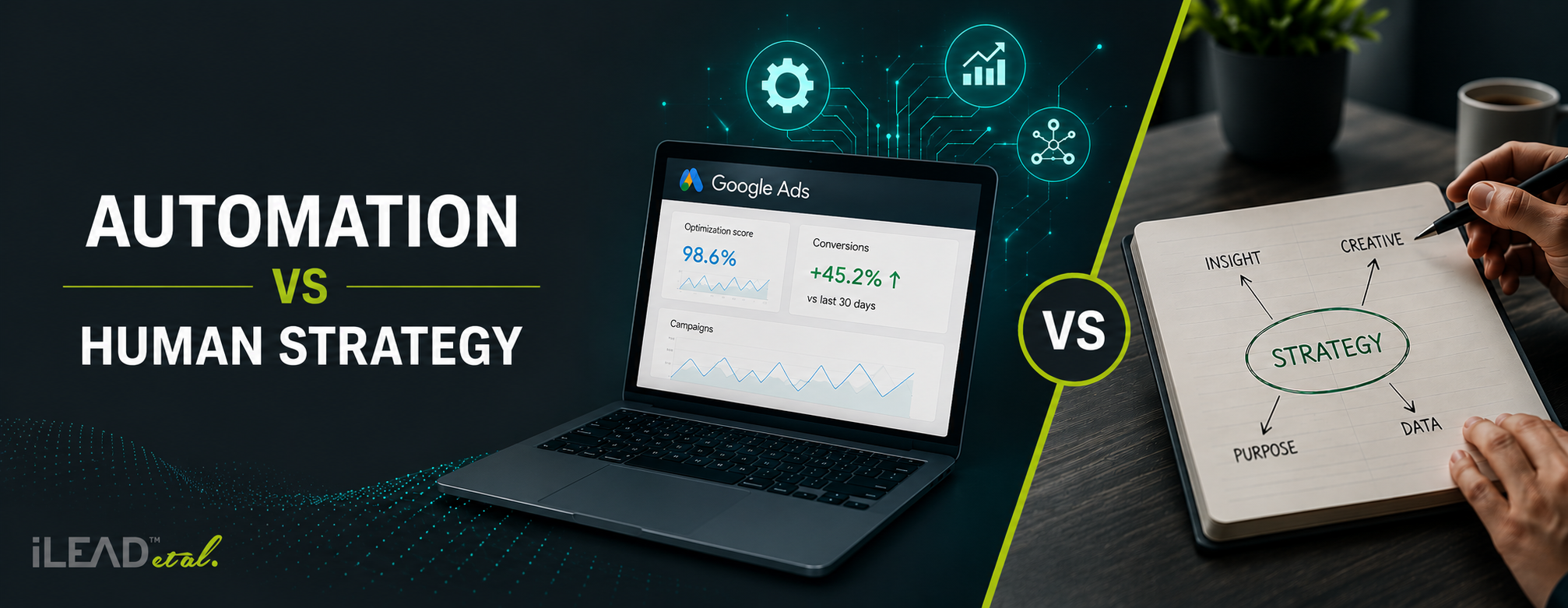
Here is what tends to get missed. Automation has changed the nature of the work, and it has raised the value of the judgement that sits behind it. The strongest accounts in 2026 pair powerful automation with experienced people who keep it pointed in the right direction. Here is where that balance sits.
What Does Google Ads Automation Actually Handle Now?
|
Google Ads automation now runs the mechanics of a campaign. Smart Bidding adjusts your bids in real time, while Performance Max decides where your ads appear across Google’s channels. The newer AI Max layer can even generate the ad copy itself. You supply the goals and the assets, and the system manages the day-to-day. |
It is worth being clear about how much the platform does without you now. The answer is a lot.
Smart Bidding reacts to live signals like device type and user intent for every auction. Performance Max runs your assets across all of Google’s main channels, from Search and YouTube through to Maps, all from one campaign. AI Max for Search widens your keywords and matches ads to landing pages, and Google reports it can deliver about 7% more conversions at a similar cost.
The platform keeps adding layers. AI Brief lets you describe your creative direction and your targeting limits in plain language, instead of setting everything by hand. Handled well, this frees your team for the bigger decisions. It is why we use these tools daily inside our Google Ads management, with a clear strategy steering them.
Does Automation Mean You No Longer Need a Strategy?
No. Automation runs your campaigns, but the choice of what you are aiming for stays with you. It amplifies the foundation you give it, so weak targeting and loose messaging scale just as fast as strong ones. The platform also serves its own priorities first, and those do not always match yours.
This single misunderstanding drains more ad budget than almost anything else.
Automation is built to protect the platform’s efficiency and revenue first, ahead of your profit margins. A campaign can look healthy on the surface while the quality of your leads quietly drops, so the reported numbers climb without the real return following.
There is a deeper point here. AI amplifies whatever foundation already exists. Unclear positioning or broken tracking gets scaled at speed. As one industry analysis notes, automation still demands close supervision, just of a different kind. That supervision is exactly where a clear digital strategy proves its worth.
Where Automation Still Falls Short
Automation has real blind spots alongside its strengths. The largest one is visibility, because you frequently cannot see what the system is doing or why.
This is far from a niche gripe. In the State of PPC 2026 survey of more than 1,300 professionals, 48% named a lack of control as their main Performance Max frustration, with 45% citing poor transparency about where ads ran and what drove the results. Over half said the job is harder than it was two years ago.
Brand safety raises a related concern. Automatically created assets can present your brand in wording you would never have signed off, and you often cannot set the rules in advance. Placement carries its own risk.
Automated campaigns chase cheap conversions, which can pull them toward poor-quality inventory. An early-2026 investigation found automated campaigns buying space on platforms that many brands had chosen to avoid, largely because the inventory came so cheap.
Tracking sits underneath all of it. The system is only as good as the data you feed it. By early 2026, roughly 73% of advertisers had adopted server-side tracking to keep their data clean. One broken conversion signal can steer the algorithm wrong for weeks before anyone spots it. The takeaway is plain: automation needs watching.
What Strategic Decisions Can’t Be Handed to the Algorithm?
Picture it this way. Automation is excellent at the question of “how”. It struggles badly with “why” and “should we”.
It will chase the cheapest conversions it can find. It will not pause to ask if those leads ever become paying customers, or if a smaller number of better leads would serve you more. That judgement, putting real business outcomes ahead of surface metrics like ROAS and CPA, belongs to people who understand your business.
The same holds for the decisions that shape a brand. Deciding which products deserve budget is a strategic choice, and so is deciding which lines to keep out of your ads. The words your brand should never use sit in the same category. How you weigh Google Ads against your wider paid media mix is a human call too. The system optimises inside the box you build for it, and building that box is the human job.
Why Does Specialist Interpretation Still Matter?
|
Because raw data only becomes useful once someone reads it with judgement. A specialist measures what the platform reports against your actual sales pipeline and catches anomalies early. They also know when to trust the automation and when to step in. AI is a capable pattern matcher, yet it carries no real grasp of your business. |
Automation generates a flood of numbers. The skill lies in knowing which of them matter.
A good specialist treats the platform’s reported results with healthy caution. They compare Google’s conversion data against your own records to separate what the system claims from what actually reaches your pipeline. That gap is often where wasted spend hides.
Interpretation is also about timing. Knowing when to leave a campaign alone to learn, and when a dip is a genuine problem, takes years to develop. As one expert panel put it, AI predicts the most likely output from the patterns it has seen, so it leans toward the statistically obvious option, which is not always the right one for your brand. This is the experience behind our Google Premier Partner status, earned each year by only the top 3% of agencies.
How to Get the Balance Right Between Automation and Human Judgement
The goal is a working partnership, where automation does what it does best and people stay in charge of direction. A few habits make that happen.
Feed the system well. Automation rewards clean conversion tracking and strong creative, and creative quality now counts as a real performance factor in its own right. Strong inputs lead to strong output, and weak inputs simply get scaled into bigger problems.
Set guardrails, then keep watch. Use exclusions and firm budget limits, along with clear performance thresholds, so the algorithm works inside sensible boundaries. Keep a genuine review rhythm and avoid the set-and-forget habit, since even Google’s most automated formats need enough data and steady attention to perform. An independent account audit is a sound way to check that your automation is genuinely working for you.
Last, recognise when to bring in specialists. An account running Performance Max and AI Max side by side turns oversight into a full job of its own. That is the point where experienced management earns its keep.
Putting Automation in Its Place
Google Ads automation ranks among the most powerful tools a business can use, and it grows more capable by the month. Power without direction, though, is just expensive motion. Two things are worth holding onto. The platform runs the campaign while you set the strategy and keep it aimed at your real goals. And the data it produces still needs a person to read it with judgement.
The wiser path puts AI and people to work together. If you want your Google Ads budget guided by specialists who know where automation helps and where judgement is needed, our Google Ads management and paid media teams are ready to help. Get in touch with iLEAD et al and let’s put your budget to better use.
Frequently Asked Questions
Can I just let Google Ads run on full automation?
You can, though it rarely serves your budget best. Automation handles the mechanics well, yet it puts the platform’s goals first and cannot judge the quality of your leads. Left without oversight, a campaign can look efficient while quietly wasting spend. Most accounts perform best when automation runs under clear goals and regular review.
What parts of Google Ads can’t be automated?
The strategic parts. Automation cannot decide what counts as a valuable conversion or how to divide budget across channels. It cannot choose which products to promote, and it cannot tell you when your tracking is broken. These judgement calls depend on understanding your business, so they stay with people.
Is Performance Max worth using in 2026?
For many businesses, yes, particularly with clean conversion tracking in place. It performs well and efficiently across Google’s channels. The catch is transparency. Plenty of advertisers report frustration with how little they can see and control, so Performance Max works best when someone reviews its results against real sales data.
Does AI Max replace the need for a PPC specialist?
No. AI Max automates more of the search campaign than any format before it, and it also runs with less human oversight, which raises the stakes when something drifts. A specialist sets the guardrails and reviews the AI-written copy, then steps in when performance slips. The automation does more, which makes the judgement around it more important than before.
How often should a Google Ads account be reviewed?
There is no single rule, though regular is the key word. Automated campaigns can shift quickly, and a broken signal or a poor placement can run up costs before it shows in the results. A steady review rhythm helps you catch problems early and keep the automation aimed at the outcomes that matter to your business.