
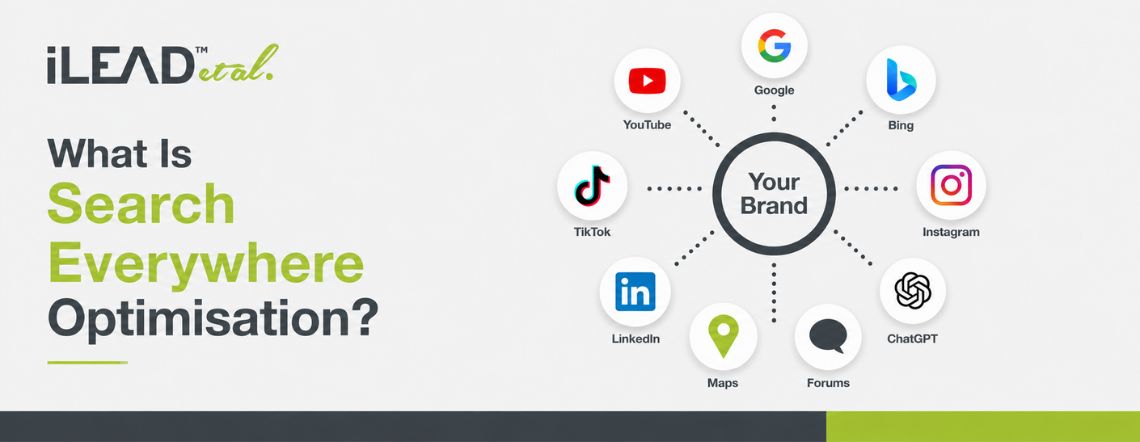
TL;DR: Search Everywhere Optimisation, a term coined by marketer Neil Patel, describes how search engine optimisation is expanding beyond Google to cover every platform where people look for answers: social apps, AI chatbots, marketplaces, and more. It isn’t a replacement for SEO, it’s what SEO is becoming. |
The word “engine” in search engine optimisation is starting to undersell what the discipline actually covers. For twenty years, SEO meant one thing: ranking well on Google. That’s no longer the whole picture, and one marketer has given the shift a name.
Neil Patel, co-founder of NP Digital, coined the term Search Everywhere Optimisation to describe SEO’s expansion across every place people now search for answers, not just Google and Bing. It’s a useful term because it captures something real: people research on TikTok, ask ChatGPT for recommendations, check Reddit before trusting a review, and search directly on Amazon before they search on Google at all. Each of those moments is a search, even though none of them happens on a traditional search engine.
This isn’t a rebrand of SEO or a reason to abandon the term everyone still searches for. It’s the next chapter of the same discipline. This article explains what Search Everywhere Optimisation means, why it matters now, and what it looks like in practice, with real examples across each platform category.
What Is Search Everywhere Optimisation?
Search Everywhere Optimisation is the practice of optimising a brand’s presence across every platform where people search for answers, not solely traditional search engines. Neil Patel introduced the term to describe this shift, framing it as the evolution of SEO rather than a separate discipline.
The core idea is straightforward. If your customers are asking questions on Google, watching explainer videos on YouTube, checking reviews on Reddit, and browsing products on Amazon, then all of those platforms function as search engines for your business. Optimising for only one of them means missing the others entirely.
This doesn’t mean starting from scratch. It means applying the same principles that have always underpinned good SEO, relevance, authority, and clarity, across a wider set of platforms than search engines alone.
Why Is SEO Expanding Beyond “Engines”?
SEO is expanding beyond traditional search engines because that’s genuinely where attention has moved. Search behaviour research backs this up more clearly than most marketing trends do.
Independent research firm SparkToro’s own analysis of web traffic found that search engines rank only fourth in overall share of unique visits, behind social media platforms, which take the largest share of where people actually spend their time online. Google still dominates referral traffic to other websites, but that’s a different measure from where people are actually looking for information in the first place.
A separate SparkToro study, based on over 300 million queries, found that Google holds more than 90% of global search market share yet accounts for under 9% of all web visits, while still sending over 60% of all referring traffic to other sites. Put simply, Google remains enormously important for sending people onward, but it’s no longer where most searching-adjacent behaviour actually happens.
That distinction matters for how a brand should think about visibility. Ranking well on Google is still valuable. It just isn’t the whole job anymore. A business that only measures success by Google rankings is looking at one part of a much larger picture of where its customers actually spend their attention.
The Five Places Search Now Happens (With Real Examples)
Patel’s own framework splits Search Everywhere Optimisation into five categories, each with its own tactics and its own kind of proof. None of them replace traditional SEO. They sit alongside it, covering the parts of the customer journey that a Google ranking alone can’t reach.
Traditional search still means Google and Bing, plus YouTube, which functions as a search engine in its own right for anyone researching a topic through video. A furniture brand ranking for “small space desk ideas” on both Google and YouTube is covering the same intent twice.
Social search covers platforms like Instagram, TikTok, and Pinterest, where people search visually rather than by typing a query into a search bar. A recipe brand optimising Pinterest board titles and pin descriptions is doing SEO, even though no search engine is involved.
AI search covers tools like ChatGPT, where people ask conversational questions and expect a synthesised answer rather than a list of links. A software company getting mentioned by name when someone asks an AI assistant for tool recommendations is benefiting from the same underlying principle as a good Google ranking: being seen as a trustworthy source.
Shopping platforms include Amazon and app stores, which are search engines for anyone already in buying mode. A product listing with a keyword-rich title and strong reviews on Amazon competes for attention the same way a webpage competes for a Google ranking.
Underdog channels cover podcasts, voice assistants, and forums like Reddit. Reddit’s influence here is significant: research from Adobe Express found that nearly two in three Americans use Reddit as a search engine at least once a week, often specifically to find opinions they trust more than a brand’s own marketing. A business that never participates in relevant subreddits is invisible in exactly the place a growing share of its prospects go to fact-check it.
Category | Example Platforms | What “Optimising” Looks Like |
Traditional search | Google, Bing, YouTube | Keyword-targeted pages, video titles and transcripts |
Social search | Instagram, TikTok, Pinterest | Keyword-rich bios, captions, and pin descriptions |
AI search | ChatGPT and similar tools | Clear, citable content and consistent brand information |
Shopping platforms | Amazon, app stores | Keyword-rich listings, reviews, strong visuals |
Underdog channels | Podcasts, voice search, Reddit | FAQ-style content, genuine participation in communities |
What Doesn’t Change: The SEO Fundamentals Still Apply
The fundamentals of good SEO don’t change under Search Everywhere Optimisation, they just get applied more widely. Every platform in the list above still rewards the same underlying qualities: relevant keywords, genuine expertise, and content that answers a real question well.
This is the same ground our own guide to AIO, AEO, and GEO covers in more technical depth, structured content, E-E-A-T signals, and schema markup all still matter. Search Everywhere Optimisation is the wider lens; those practices are how you actually implement it on each platform.
What changes is the format, not the philosophy. A Pinterest pin needs a strong image and a clear title instead of a meta description. A ChatGPT mention depends on being cited elsewhere online instead of ranking directly. An Amazon listing depends on reviews and specific product detail instead of backlinks. The skill underneath, understanding what your audience is actually looking for and giving them a clear, credible answer, stays exactly the same across every one of these formats.
How to Start Applying This to Your Business
Start applying Search Everywhere Optimisation by identifying where your specific customers already search, not by trying to cover every platform at once. Few businesses have the resources to optimise for five categories simultaneously, and most don’t need to.
Check your analytics for where traffic and enquiries already originate, then ask your customers directly which platforms they use to research a purchase like yours. A B2B software company will likely get more value from LinkedIn and AI search than from Pinterest. A retail brand selling visually distinctive products might see the opposite.
Once you know where to focus, apply the same principles already covered here: clear, keyword-aware content, genuine expertise, and consistency across whichever platforms you choose. Expanding to additional platforms becomes far easier once the first one is working, since much of the underlying content, research, and brand messaging carries across with only format changes.
For AI-specific platforms in particular, our AI marketing services cover how to build the kind of citable, consistent presence that AI tools tend to reference.
Where iLEAD et al Fits In
Search Everywhere Optimisation is still, fundamentally, search engine optimisation. That’s why our SEO services remain the foundation of how we help South African businesses stay visible, across a Google ranking, a YouTube result, or a mention inside an AI-generated answer.
We build content strategies designed around where your specific customers already look, rather than spreading effort evenly across every platform Patel describes. That’s the difference between chasing a trend and applying it usefully.
The Bottom Line
Search Everywhere Optimisation gives a name to something that was already happening: search has outgrown search engines. Neil Patel deserves credit for naming it clearly, but the underlying work is still SEO, applied with a wider view of where your customers actually look for answers. Treating it as an aspiration rather than a checklist is the right way in, most businesses will never need all five categories at once, and that’s fine.
Start with the platforms your customers already use, apply the same fundamentals that have always worked, and expand from there. If you’d like help working out where that is for your business, get in touch and we’ll help you map it out.
Frequently Asked Questions
Who coined the term Search Everywhere Optimisation?
Neil Patel, co-founder of NP Digital, coined the term to describe how SEO is expanding beyond traditional search engines to cover every platform where people search for answers.
Is Search Everywhere Optimisation different from SEO?
No, it’s an extension of SEO rather than a separate discipline. It applies the same core principles, relevance, authority, and clarity, across platforms beyond Google and Bing, including social apps, AI tools, and marketplaces.
Do I need to optimise for every platform at once?
No. Most businesses get better results by identifying the one or two platforms their customers already use most, optimising those well, and expanding gradually rather than spreading effort too thin.
How does Search Everywhere Optimisation relate to GEO and AEO?
GEO (generative engine optimisation) and AEO (answer engine optimisation) are specific practices within the AI search category of Search Everywhere Optimisation. Search Everywhere Optimisation is the broader umbrella; GEO and AEO are two of the tactics used within it.
Is Google still worth optimising for?
Yes. Google still sends the majority of referral traffic to websites, even though it accounts for a smaller share of overall time people spend searching across all platforms. Traditional SEO remains a core part of Search Everywhere Optimisation, not a replacement for it.